

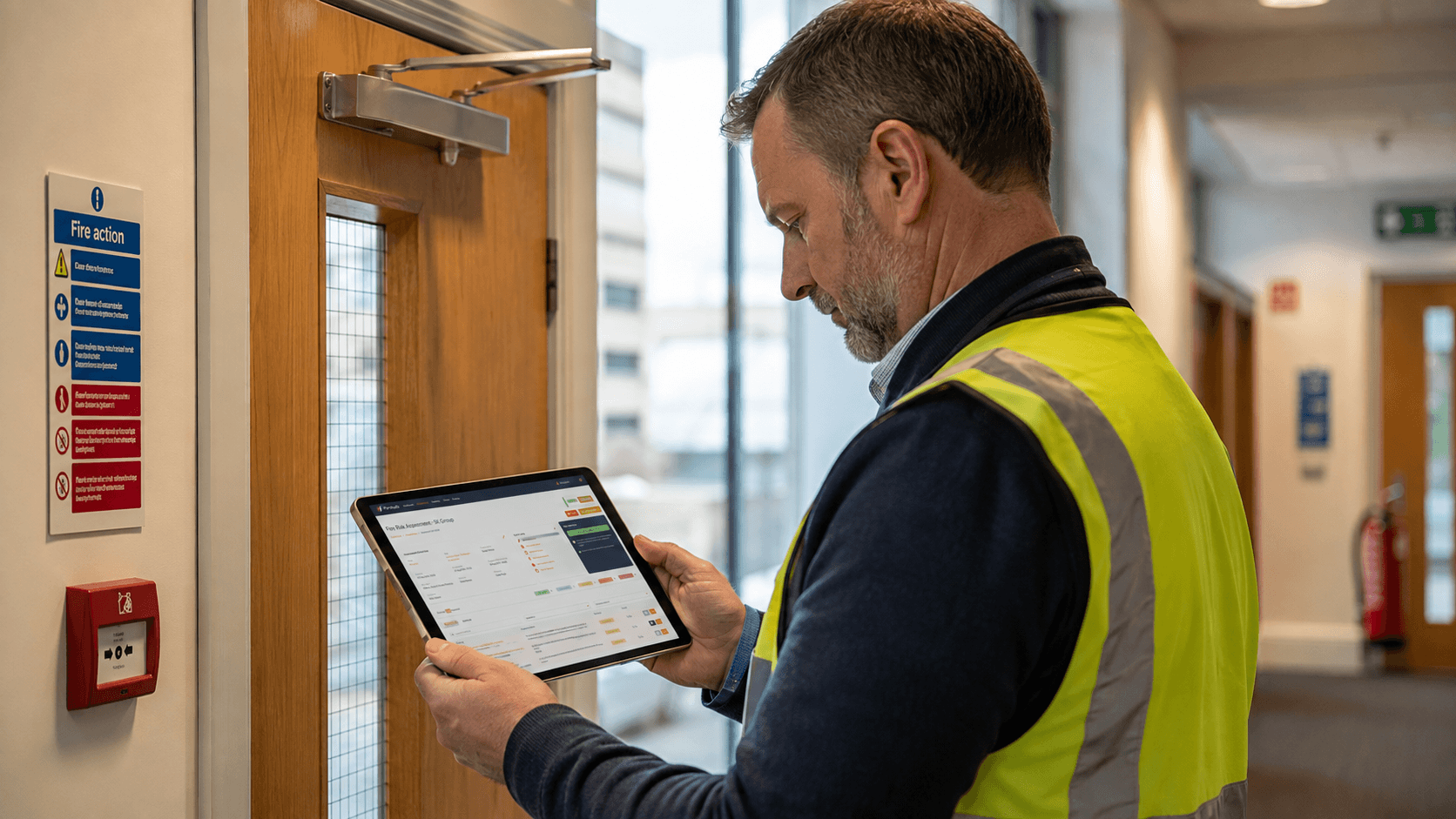

If you’ve spent any time in the fire safety industry, you’ll know PAS 79 inside out. It’s the British Standards Institution’s published guidance for carrying out and recording fire risk assessments, and it’s become the de facto methodology that most competent assessors work to, whether they’re inspecting a single shopfront or a 40-site retail portfolio. What’s changed in the last few years isn’t the standard itself — it’s how assessors are getting the work done. PAS 79 fire risk assessment software has quietly become the norm rather than the exception, and it’s worth understanding why.
What does PAS 79 actually ask of an assessor?
PAS 79 sets out a structured, risk-based approach to identifying fire hazards, evaluating the people at risk, and recording findings in a consistent, defensible format. It covers things like:
- Identifying fire hazards and sources of ignition, fuel and oxygen
- Evaluating the people at risk, including anyone especially vulnerable
- Assessing existing fire precautions and where they fall short
- Recording significant findings, including a clear action plan with priorities and timescales
- Reviewing the assessment periodically, or whenever circumstances change
None of that is complicated in theory. In practice, doing it properly, on site, for the twentieth time that month, while keeping every client’s paperwork organised and every action tracked to completion, is a different story altogether.
Why paper and spreadsheets start to creak
Most assessors we speak to didn’t set out to build a filing system — they set out to keep buildings safe. But a Word template and a shared spreadsheet only get you so far. The usual pain points are familiar to anyone who’s been doing this for a while:
- Inconsistent reports. Different assessors (or the same assessor on a bad day) end up phrasing things differently, missing sections, or using slightly different risk ratings from job to job.
- Evidence that goes missing. Photos taken on a phone rarely make it into the report cleanly, and clients understandably want to see what you saw.
- No visibility on outstanding actions. A report gets filed, but who’s actually checking whether the fire door closer got fixed?
- Admin eating into billable hours. Writing up notes back at the office, late at night, after a full day of site visits.
- Renewal dates falling through the cracks. Annual reviews should be proactive, not something a client has to chase you for.
None of these are failures of the assessor. They’re failures of the tools.
Where dedicated PAS 79 fire risk assessment software changes the picture
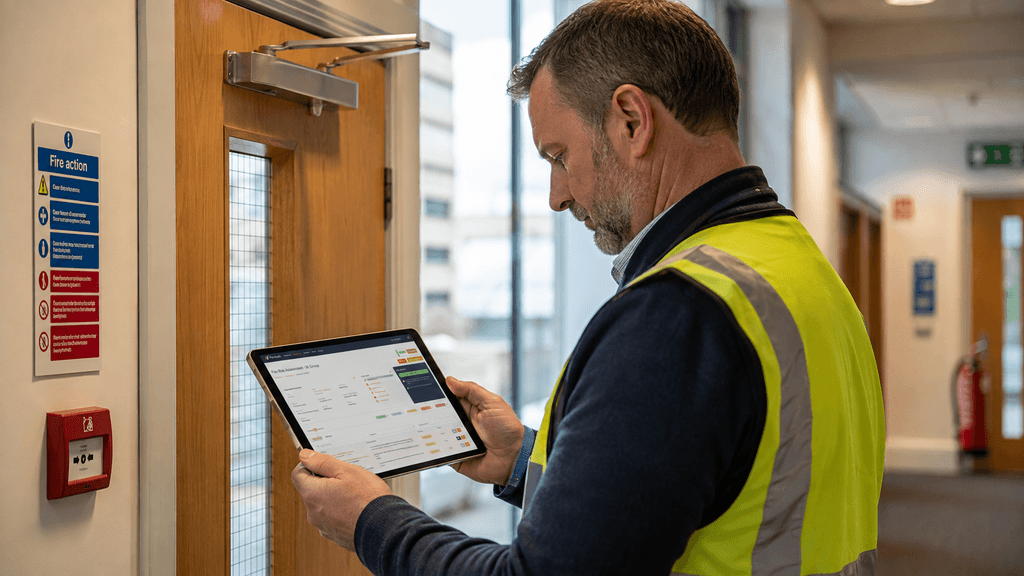
This is where purpose-built PAS 79 fire risk assessment software earns its keep. Rather than adapting a generic form builder or health-and-safety platform, the better tools in this space are built specifically around the PAS 79 methodology — pre-populated question and answer libraries structured the way the standard expects, editable so you can reflect your own house style, and designed to be filled in on a tablet while you’re actually walking the building.
The practical benefits tend to fall into a few buckets:
Consistency across every report. When the assessment structure is built into the software, every report your team produces follows the same logic and the same standard of language, regardless of which assessor is on site.
Photo and evidence capture, done properly. Snap a picture of the fire door that won’t self-close, tag it to the relevant finding, and it’s in the report — no emailing yourself photos at 6pm.
Offline working. Basements, plant rooms and rural sites don’t always have signal. Good software captures everything locally and syncs once you’re back online, so a dead spot in the building doesn’t mean starting again.
A single, searchable record. Every report, every client, every site, in one place — searchable, secure, and available instantly if a client or enforcing authority asks for historic evidence.
Action tracking that doesn’t rely on memory. Significant findings get assigned, dated and chased, rather than living in a PDF nobody revisits until the next annual review.
A client-facing view. Larger clients in particular increasingly expect self-service access to their own reports, upcoming assessment dates and outstanding actions across their estate, rather than relying on email chains with the assessor.
For a sole trader, this is the difference between finishing a job on site and finishing it a week later. For a consultancy with a team of assessors and subcontractors, it’s the difference between hoping report quality is consistent and knowing it is.
Multi-site organisations feel this most acutely
If you’re managing fire safety compliance across dozens or hundreds of locations — a retail estate, a local authority’s property portfolio, a housing association’s stock — the stakes are different again. It’s not just about producing a good report; it’s about having a central, portfolio-level view of significant findings, being able to allocate actions to the right internal team or contractor, and being able to demonstrate a clean audit trail if you’re ever asked to. Spreadsheets and inboxes simply don’t scale to that.
How we approach PAS 79 fire risk assessment software
We carry out FRAs for clients across the UK, from single-site businesses through to large, multi-location organisations, and we’ve built our own delivery around software rather than paper for exactly the reasons above. We use Firehub nationwide across our client base, including for organisations like Frasers Group, Derbyshire County Council and Theo Paphitis Retail Group — clients where consistency, evidence and a clear audit trail across many sites genuinely matter, and where our own assessors need to work efficiently on the road without compromising on the quality of the report.
It’s not the only way to run a fire risk assessment practice, but for us it’s removed a lot of the friction between doing the assessment and delivering a report a client can actually act on.
If you’re weighing up your own options
Whether you’re an independent assessor tired of formatting reports at 9pm, or you’re responsible for fire safety compliance across a growing estate and want a clearer picture of what’s outstanding, it’s worth seeing what dedicated PAS 79 fire risk assessment software looks like in practice rather than taking it on faith.
FireHub run short, no-obligation demos if you’d like to see how it actually works day to day — you can book a slot directly here.
Either way, the standard itself isn’t going anywhere, and nor is the expectation that fire risk assessments are thorough, evidenced and easy to act on. The question is really just how much of the admin around that you want to be doing by hand.